Caving with CMRU
by Mardi Keltner

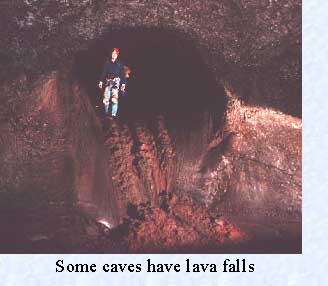 The members of CMRU are active in various outdoor pursuits, one of which is caving. The local Cascade Mountains are of volcanic origin and there are many lava caves along their slopes. (These lava caves form when the surface of a lava flow hardens while the still molten interior continues to flow. Depending on the terrain, the caves can form simple tubes to complex mazes. On steep terrain they may have "pool and drop" formations similar to steep mountain streams.)
 |
||
|
|
||
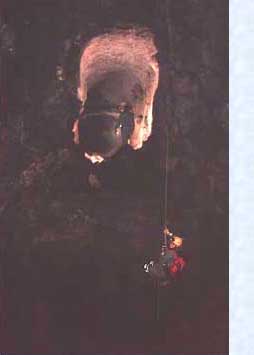 No matter what our level of expertise, caving offers us a chance to hone our vertical rope techniques, practice rigging in unusual circumstances, and train while working together in dark and cramped environments.
Practicing rope travel skills |
||
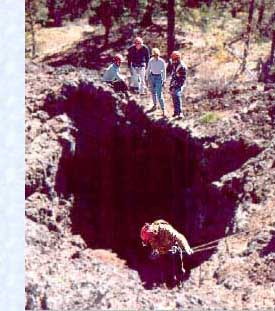 Our training paid off in August of 1990 when we were asked to search a series of spatter-cone pits in the Cascade Mountains for a missing 13-year old girl. These pits are up to 150 feet deep, and several of them are located less than a mile from where the girl was last seen. It was an especially risky mission because of the sharp, unconsolidated rock from which the pits are formed.
 Jon rappels into an 85 foot deep |
||
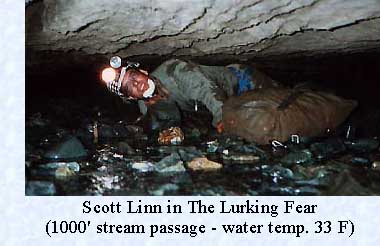 CMRU is among those who will be called in case of a caving accident in the Mountains of Northern California. This area contains many notable caves, including Big Foot which currently has over 15 miles of mapped passages. The caves in this area are isolated, very difficult to access, and extremely cold. The Klamath Mountain Conservation Task Force (the group exploring and mapping these caves) is justifiably concerned for the safety of their participants and has arranged for appropriate SAR resources to be available in case of an accident.
 |
||
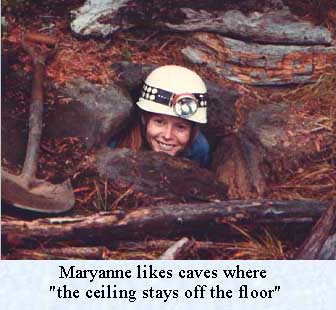 |
||

| ||
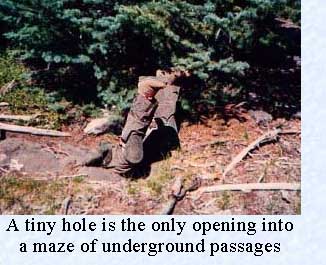 |
||
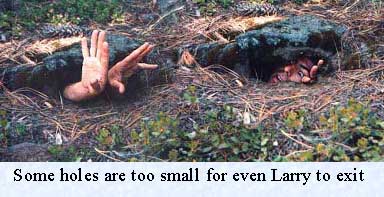
Photos by Larry King and Mardi Keltner |
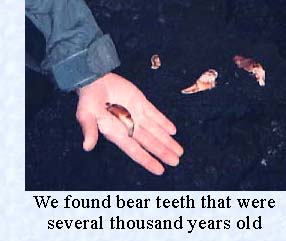
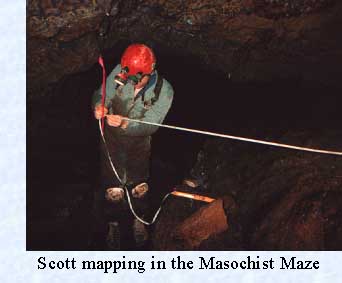 For many of our members the caves offer the fun of experiencing a unique environment, while others are more serious National Speleological Society members who participate in cave mapping, conservation, and preservation projects. Scott Linn, a CMRU member since 1990, has done serious cave exploration all over the world. He assisted in a difficult four-day technical evacuation of an injured caver from Lechuguilla Cave in 1991, and has participated in many multi-day caving expeditions.